
A diagnosis of male infertility can feel like the ground has shifted beneath you. It raises immediate and deeply personal questions — is this permanent? Will I ever be able to have children? Is there any real hope? These are not just medical questions; they are emotional ones, and they deserve honest, thoughtful answers.
The truth is that male infertility is not a single condition with a single outcome. It is an umbrella term covering dozens of different underlying causes — each with its own treatment pathway, its own success rates, and its own realistic prognosis. For many men, the condition is entirely reversible. For others, the goal shifts from “curing” infertility to finding effective ways to work around it. And in both categories, the outcomes today are far better than they were even a decade ago.
First, What Does “Cured” Actually Mean?
It is worth pausing on the word “cured.” In the context of male infertility, a cure could mean different things to different people. For some, it means achieving a normal semen analysis after treatment. For others, it simply means successfully fathering a child — regardless of whether that happens naturally or with medical assistance.
This distinction matters because focusing only on whether a test result returns to normal can be misleading. A man whose sperm count remains below average after treatment but who goes on to conceive naturally has, in the most meaningful sense, been successfully treated. Medicine increasingly evaluates success by outcomes rather than numbers alone.
Causes That Can Often Be Fully Treated
A significant proportion of male infertility cases have identifiable, treatable causes. When the right diagnosis is made and the right treatment is applied, sperm parameters — and natural fertility — can return to normal.
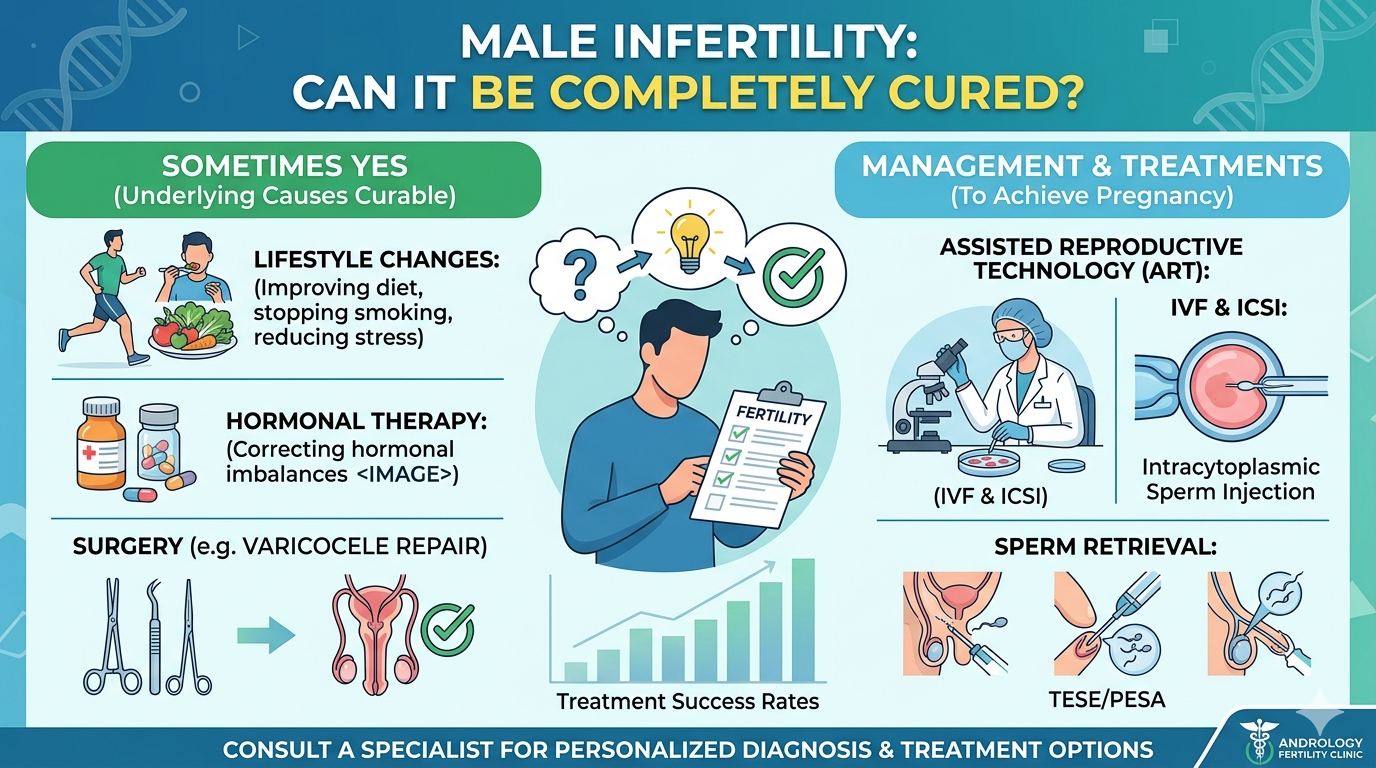
Varicocele is the single most common treatable cause of male infertility, found in up to 40 percent of men investigated for fertility problems. It involves enlarged veins in the scrotum that raise testicular temperature, disrupting sperm production. Surgical repair — particularly microsurgical varicocelectomy — leads to meaningful improvement in sperm parameters in 60 to 70 percent of men, with natural pregnancy rates of 35 to 50 percent within 12 to 18 months post-surgery.
Hormonal deficiencies such as hypogonadotropic hypogonadism — where the pituitary gland fails to send the right signals to the testes — are highly responsive to treatment. Gonadotropin injections stimulate the testes directly and can restore sperm production in men who previously had little to none. Pregnancy rates with this treatment are among the highest in male infertility medicine, reaching 50 to 70 percent in well-selected cases.
Infections affecting the reproductive tract — including epididymitis, orchitis, or sexually transmitted infections — can impair sperm quality and sometimes cause scarring that blocks sperm transport. When identified and treated early with appropriate antibiotics, the damage can be minimised or reversed.
Obstructive azoospermia — where sperm are being produced normally but cannot exit due to a blockage — is one of the most satisfying conditions to treat. Microsurgical reconstruction of the vas deferens or epididymis can restore sperm flow. Success depends on the location and cause of the blockage, but in skilled hands, results are excellent.
Retrograde ejaculation — a condition where sperm travel backwards into the bladder rather than forward during orgasm — can often be managed with medications that tighten the bladder neck, or by retrieving sperm from urine for use in assisted reproduction.
Causes That Require a Different Kind of Help
Some causes of male infertility cannot be reversed in the traditional medical sense. This does not mean fatherhood is impossible — it means the approach shifts toward working with what is available rather than restoring what has been lost.
Genetic causes such as Klinefelter syndrome (an extra X chromosome) or Y-chromosome microdeletions affect sperm production at a fundamental level. These cannot be corrected. However, some men with Klinefelter syndrome do produce small numbers of sperm — and these can be retrieved surgically and used in IVF with ICSI to achieve conception.
Non-obstructive azoospermia — where the testes simply do not produce sperm, or produce so few that none appear in the ejaculate — is one of the most challenging diagnoses. Yet even here, hope exists. Surgical sperm retrieval procedures like TESE (Testicular Sperm Extraction) can find viable sperm in the testicular tissue in 40 to 60 percent of cases, which can then be used in IVF with ICSI.
Severe sperm DNA fragmentation — damage to the genetic material inside sperm — can cause recurrent IVF failure or early pregnancy loss even when sperm counts appear normal. Treatment options include antioxidant therapy, lifestyle changes, varicocele repair, and in some cases, surgically retrieved sperm (which tend to have lower DNA fragmentation than ejaculated sperm).
The Role of Lifestyle in Recovery
For a significant number of men, poor sperm quality is not caused by a medical condition but by lifestyle factors that are entirely within their control. Smoking, heavy alcohol consumption, obesity, anabolic steroid use, chronic stress, heat exposure, and poor diet all negatively impact sperm production — sometimes dramatically.
The good news is that the effects of lifestyle on sperm are largely reversible. Quitting smoking, reducing alcohol, losing excess weight, and improving diet can produce meaningful improvements in sperm parameters within three to six months — sometimes enough to enable natural conception without any medical treatment at all.
This is not a minor footnote. For men with mild to moderate sperm issues and identifiable lifestyle contributors, these changes are often the most powerful intervention available. They are free, they have no side effects, and they improve overall health regardless of their fertility impact.
The 90-Day Rule
Any discussion of treating male infertility must include an understanding of the spermatogenesis cycle. From the moment a sperm cell begins developing to the moment it appears in the ejaculate takes approximately 70 to 90 days. This means that the effects of any treatment — whether surgery, medication, or lifestyle change — will not be visible in a semen analysis for at least three months.
This is one of the most important things for men undergoing treatment to understand. Abandoning a treatment after four or six weeks because “nothing has changed” is premature. The evidence of change simply has not had time to appear yet. Patience, consistency, and a follow-up semen analysis at the three-month mark are essential parts of the process.
Realistic Hope vs False Promises
It would be dishonest to suggest that every case of male infertility can be cured. Some conditions — particularly severe genetic causes or long-standing non-obstructive azoospermia — may not be reversible. But even in these cases, the landscape is far from hopeless. Assisted reproductive technology, particularly IVF with ICSI, has transformed outcomes for men who would previously have had no path to biological fatherhood.
What matters most is getting an accurate diagnosis. Treatment without a clear understanding of the cause is guesswork. With the right diagnosis, your andrologist can give you a realistic assessment of your specific situation — not a population statistic, but a genuine picture of what is possible for you.
Final Thoughts
Male infertility is not a verdict. For many men it is a temporary and treatable condition. For others it is a challenge that requires a different kind of solution. But in almost every case, there is a path forward — whether that leads to natural conception after treatment, to assisted reproduction, or to a combination of both.
The first and most important step is to seek an expert evaluation rather than assume the worst. An andrologist can turn a frightening diagnosis into a clear, actionable plan — and in this field, that plan leads to success far more often than most men realise.